
The $40 Trillion Question: When Does Debt Become a Problem?
There are financial headlines worth paying attention to—not because they tell us what the market will do tomorrow, but because they can change the environment in which investors make decisions for years to come.
The U.S. national debt has surpassed $40 trillion. Long-term Treasury yields have climbed sharply, with the 30-year Treasury recently reaching levels not seen since 2007. The federal government is also projected to run a deficit of approximately $1.9 trillion this year, despite the economy not being in a major recession.
None of these developments, by itself, means a financial crisis is coming. But together they raise an important question:
When does the amount of debt—and, more importantly, the cost of carrying that debt—begin to meaningfully affect the economy and financial markets?
The concern isn’t simply that the United States has a lot of debt. It is that carrying that debt is becoming increasingly expensive. And because Treasury rates influence borrowing costs throughout the economy, what happens in the bond market doesn’t necessarily stay there.
The Debt Is Large. The Interest Bill May Matter More.
The federal government routinely spends more than it collects in revenue. The difference is the federal deficit, which is financed by issuing Treasury bills, notes, and bonds.
For many years following the financial crisis, extraordinarily low interest rates made a growing debt burden easier to finance. That environment has changed.
Consider a homeowner with a large mortgage at 3%. The balance may be manageable at that rate. If it eventually has to be refinanced at 5%, 6%, or 7%, the principal hasn’t changed—but the cost of carrying it has.
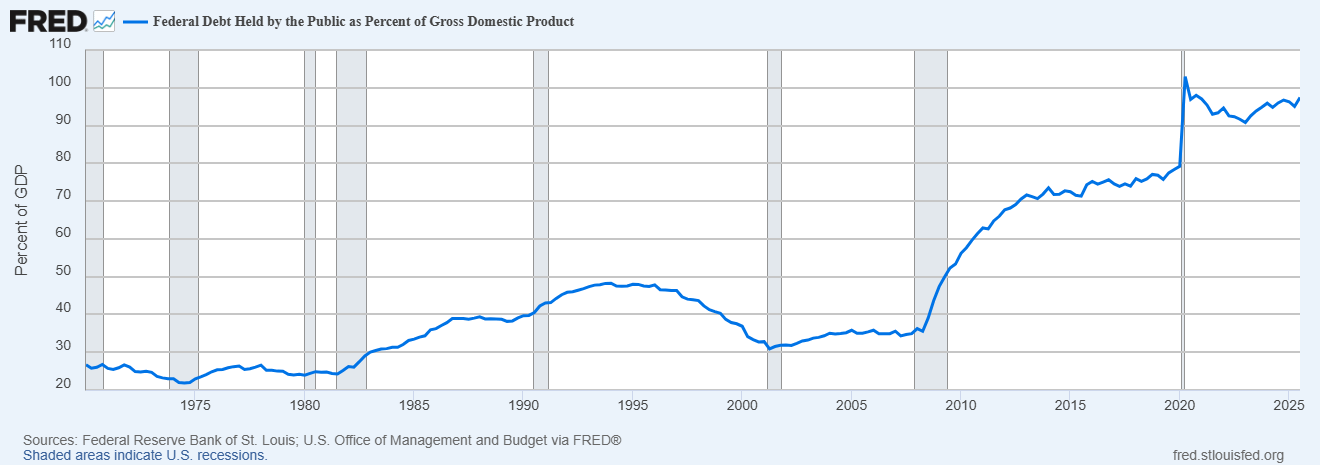
The federal government faces a similar dynamic. Government debt matures continuously, and the Treasury generally issues new debt to refinance maturing obligations while also borrowing to fund ongoing deficits.
As older, lower-rate debt is replaced with debt carrying today’s higher rates, interest expense rises.
The Congressional Budget Office estimates that net federal interest expense will total approximately $1 trillion this year and rise to approximately $2.1 trillion by 2036. By then, interest expense alone is projected to equal approximately 4.6% of the U.S. economy and nearly equal all federal discretionary spending.
This creates a difficult feedback loop:
More debt → more interest expense → larger deficits → more borrowing → more debt.
Higher interest rates make that cycle more difficult to manage.


Why Treasury Yields Matter to Investors
The 10-year Treasury is one of the foundational interest-rate benchmarks in the global financial system. Mortgage rates, corporate borrowing costs, business investment decisions, and stock valuations are all influenced by Treasury yields.
As Treasury yields rise, those effects can spread through the economy. A family may postpone a mortgage. A business may delay an expansion. A company refinancing its debt may have less cash available for hiring or investment. Investors may also find Treasury yields attractive enough to demand higher expected returns before taking additional risk.
None of these developments necessarily causes a recession. But collectively, higher borrowing costs can slow economic activity.
For investors, that is why Treasury yields matter: they influence the price of money across the economy.
Why Are Treasury Yields Rising?
There is no single explanation. Interest rates reflect expectations for inflation, economic growth, Federal Reserve policy, and global demand for U.S. assets. But the amount of debt the United States needs investors to absorb is increasingly important.
The federal government is projected to run a deficit of approximately $1.9 trillion this year, requiring the Treasury to continue issuing substantial amounts of new debt.

When the supply of bonds increases—or investors perceive greater risks related to inflation, fiscal policy, or future debt levels—they may demand higher yields before lending money for 10, 20, or 30 years.
Higher yields then increase the government’s future borrowing costs, reinforcing the cycle.
The important question isn’t simply whether yields are rising. It is why they are rising and what is happening alongside them.
Treasury Buybacks: Managing Debt Isn’t Reducing It
Recent headlines about the Treasury increasing its bond buyback program raise a reasonable question: How does a government that is already borrowing money buy back its own debt?
The key distinction is that a Treasury buyback is not necessarily the same as paying down the national debt.
Treasury can repurchase older bonds while continuing to issue other Treasury securities. Buybacks can improve liquidity and help manage the composition of outstanding debt. In response to recent bond-market pressure, Treasury announced that it would at least double the maximum size of certain buybacks involving 10- to 30-year securities.
That may help the market function more smoothly, but it doesn’t solve the underlying fiscal problem.
Think of it as refinancing a mortgage: changing the terms or structure of the obligation doesn’t necessarily eliminate the debt.
Managing debt and reducing debt are two very different things.
Ultimately, changing America’s debt trajectory requires changing the relationship between what the government spends, what it collects, and how quickly the economy grows.
What Would Concern Us More?
High debt does not mean a financial crisis is imminent. Nor does a 5% Treasury yield. Higher yields can even reflect positive developments such as strong economic growth.
What would concern us is a combination of developments that begin reinforcing one another:
Long-term Treasury yields continue rising even as expectations for Federal Reserve rates stabilize or decline.
Investors consistently demand greater compensation to own longer-term U.S. government debt.
Treasury auctions show persistent signs of weakening demand.
Federal interest expense consumes an increasing share of government revenue and economic output.
Large deficits persist even during periods of relatively strong economic growth.
Higher Treasury rates increasingly affect mortgages, housing, corporate borrowing, business investment, and consumer spending.
Policymakers have less flexibility to respond to the next recession or financial emergency because more federal resources are committed to servicing existing debt.
One indicator doesn’t make a crisis. The concern is when multiple vulnerabilities begin interacting.
Is This Like 2008?
Not exactly. The 2008 financial crisis was fundamentally a private-sector credit crisis. Housing prices had risen dramatically, lending standards deteriorated, households became highly leveraged, and financial institutions accumulated enormous exposure to mortgages and mortgage-backed securities. Falling housing prices eventually exposed weaknesses throughout the financial system.
Today’s concern is different. The vulnerability discussed here sits primarily within government finances and the sovereign bond market, not subprime mortgages. Banks are better capitalized, mortgage underwriting standards are substantially different, and we do not currently see a direct equivalent of the poorly underwritten mortgage debt that sat at the center of 2008.
There is nevertheless an important lesson from 2008: individual risks can appear manageable until they begin interacting.
The same principle applies today. High government debt, higher interest rates, large deficits, and inflation concerns may each be manageable on their own. But when higher rates increase interest expense, which contributes to larger deficits, which requires greater Treasury issuance, which potentially pushes borrowing costs higher still, the interaction deserves attention.
Investing in Unfamiliar Waters
The next crisis rarely looks exactly like the last one. The technology bubble wasn’t the savings and loan crisis. The 2008 financial crisis wasn’t the technology bubble. The pandemic wasn’t 2008. Each period created circumstances that investors had not experienced before. That doesn’t mean we should assume the worst whenever conditions change. It means we should recognize that markets can surprise us. This is where diversification and financial planning matter.
A sound financial plan shouldn’t require interest rates to move in one particular direction, depend on one asset class always outperforming, or require us to predict the exact timing of the next recession or market crisis. Uncertainty is part of investing.
Final Thought
For now, we believe the appropriate response is awareness—not alarm.
The United States remains the world’s largest economy, and the Treasury market remains the foundation of the global financial system. But those facts don’t mean we should ignore a changing fiscal landscape.
Federal debt held by the public is projected to rise from approximately 101% of GDP today to 120% by 2036. Over that same period, annual net interest expense is projected to more than double. Those numbers matter. So does the message coming from the bond market.
The question investors should be asking isn’t simply: “How much does the United States owe?” A more important question may be: “What does it cost to carry that debt—and what happens to the broader economy if that cost continues to rise?” We don’t know precisely how this chapter will unfold. No one does. But we’ve navigated unfamiliar environments before, and we will again. Our job isn’t to predict every turn in the economy. It is to understand changing risks, plan for a range of outcomes, and make thoughtful decisions without allowing either complacency or fear to dictate the strategy.
At The Legacy Foundation, that remains our approach: pay attention, understand what is changing, and keep the long-term plan at the center of the conversation.

Complementary Portfolio Review
We understand that taking the first step toward financial planning can feel overwhelming. That’s why we offer portfolio reviews to anyone looking for thoughtful financial guidance—something we’ve been helping individuals and families navigate for more than 35 years.
Disclaimer:
These views are those of the author, not of the broker-dealer or its affiliates. This material contains an assessment of the market and economic environment at a specific point in time and is not intended to be a forecast of future events or a guarantee of future results. All investments involve risk, including loss of principal. Forward-looking statements are subject to certain risks and uncertainties. Actual results, performance, or achievements may differ materially from those expressed or implied. Information is based on data gathered from what we believe are reliable sources.
Government bonds and Treasury bills are guaranteed by the US government as to the timely payment of principal and interest and, if held to maturity, offer a fixed rate of return and fixed principal value.
Bond yields are subject to change. Certain call or special redemption features may exist which could impact yield.
No investment strategy can guarantee a profit or protect against loss in periods of declining values. There is no guarantee that a diversified portfolio will enhance overall returns or outperform a non-diversified portfolio. Diversification does not protect against market risk.
The Gross Domestic Product (GDP) is a comprehensive measure of U.S. economic activity. GDP measures the value of the final goods and services produced in the United States (without double counting the intermediate goods and services used up to produce them). Changes in GDP are the most popular indicator of the nation's overall economic health.