
Is Your Retiree Health Plan the Right Fit for Medicare?
Turning 65? What to Know About Your Medicare Options
Medicare's annual enrollment period opens October 15, so this month we're covering the basics: when to enroll, how the main options compare, and what to consider before you decide.
If you've worked for a Virginia public university or state agency, you may also have access to a state retiree plan called Advantage 65. Despite the name, it isn't a Medicare Advantage plan. More on that below.
When to enroll
Your Initial Enrollment Period is seven months: the three months before the month you turn 65, that month, and the three months after. If you already receive Social Security, you'll usually be enrolled in Parts A and B automatically.
If you're still working at 65 and covered by your employer's plan, you can usually delay Part B without a penalty. Once that coverage ends, you have eight months to enroll.
Enrolling late can cost you:
Part B: your premium goes up 10% for each full 12 months you went without it, for as long as you have Part B.
Part D: a lifetime penalty if you go 63 days or more without creditable drug coverage.
State retiree plan: Virginia's program requires retirees to enroll in Parts A and B as soon as they're eligible. If you don't, the plan won't pay what Medicare would have.
In 2026, the standard Part B premium is $202.90 a month, with a $283 deductible. Higher earners pay more, as explained below.
Once you're enrolled, you can change your coverage each year from October 15 to December 7. Changes take effect January 1.
Why your income matters
If your income is above a certain level, you pay more for Part B and Part D. This surcharge is called IRMAA (income-related monthly adjustment amount). It's based on your tax return from two years earlier, so 2026 premiums are based on 2024 income.
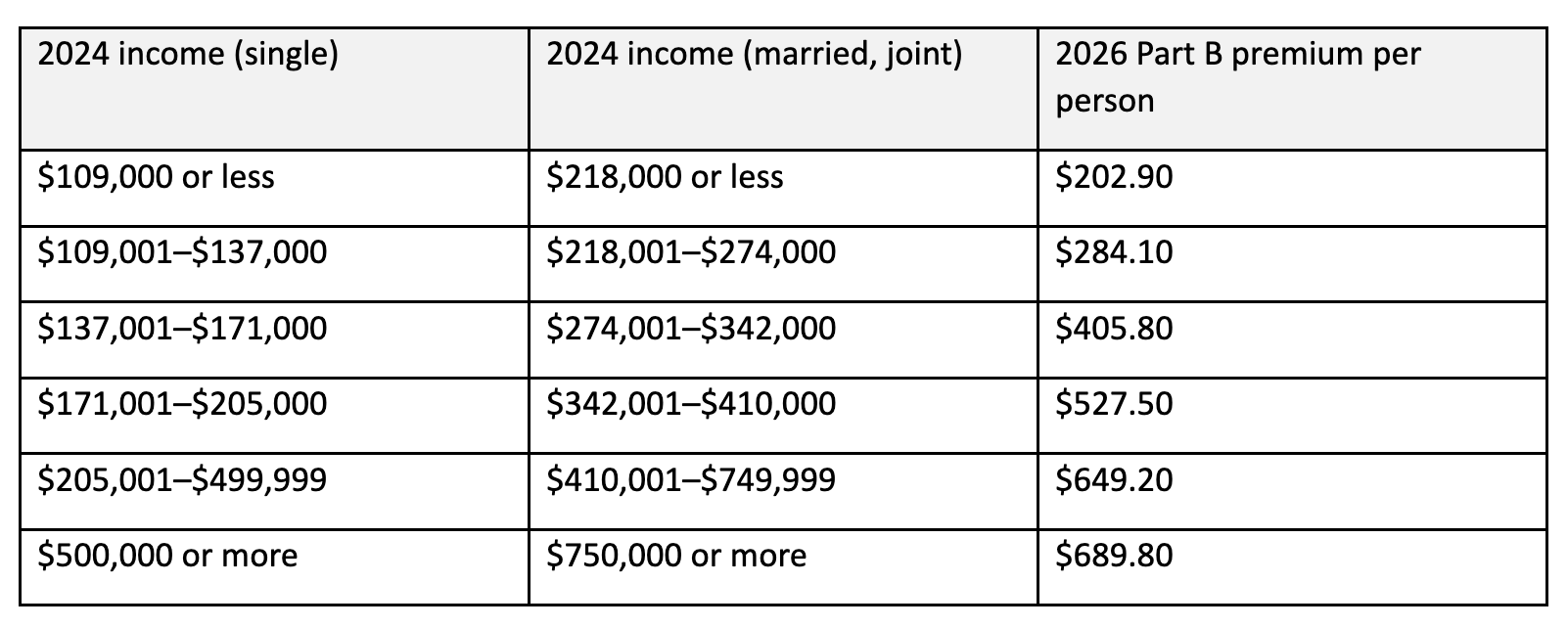
Drug coverage has its own surcharge on top of your plan premium, from $14.50 to $91.00 a month in 2026. It applies whether your drug coverage comes through Advantage 65, Medicare Advantage, or a stand-alone Part D plan.
A few points to keep in mind:
Your first year of retirement may be based on your last working years. If you retire at 65, your premiums may reflect a full salary from two years before.
You can ask for a new determination. If your income dropped because you stopped or cut back on work, you can ask Social Security to use your current income instead, using Form SSA-44.
One-time income counts. Retirement account withdrawals, Roth conversions, and the sale of a home or investments can push you into a higher bracket two years later. Crossing a threshold by even $1 triggers the full surcharge for that tier.
This is one of the easier Medicare costs to plan for. Timing withdrawals from a 403(b) or 457(b), spreading out Roth conversions, and watching the brackets year to year can help keep premiums lower.
Your three main options
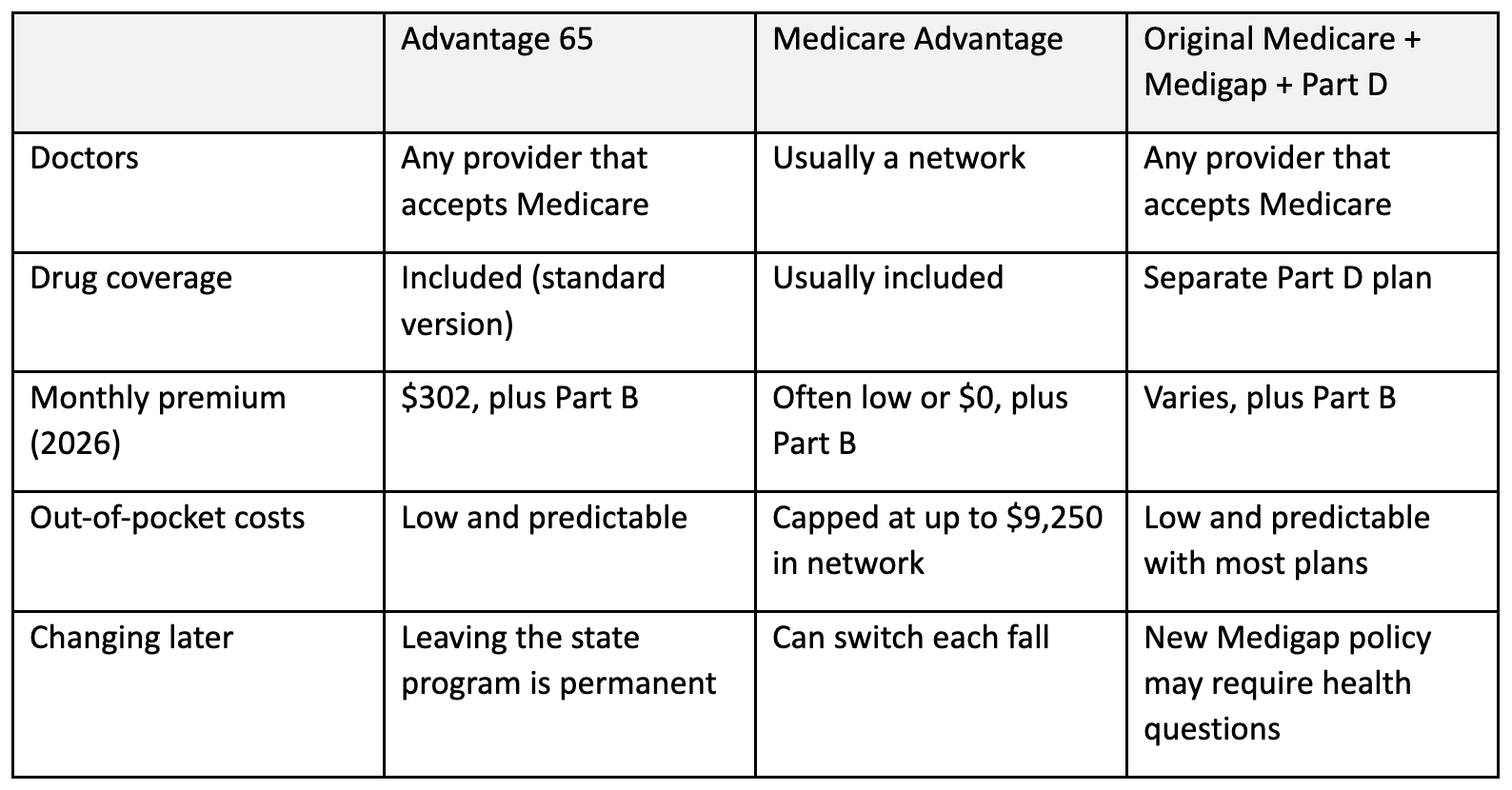
Original Medicare (Parts A and B) doesn't cap your out-of-pocket costs or cover most prescriptions. Most people fill those gaps in one of three ways.
Original Medicare + Medigap + Part D. Medicare pays first, and a supplement covers most of the rest. You can see any provider that accepts Medicare. You buy each piece separately.
Medicare Advantage (Part C). A private plan that handles your Medicare benefits. It usually includes drug coverage and extras, often with a low premium. Most use a provider network and may require referrals or prior authorization.
Advantage 65. Virginia's state retiree Medicare supplement, administered by Anthem. Medicare pays first, and Advantage 65 pays second. The standard version includes Part D drug coverage. There's also a medical-only version and an optional dental and vision add-on. It works like a Medigap policy, not like Medicare Advantage.
To qualify, you generally need five years of benefited state service, eligibility for a monthly retirement benefit, and enrollment in the employee health plan on your last day of work.
How they compare
Advantage 65
Pros: see any Medicare provider nationwide, predictable costs, drug coverage included, no health questions to enroll. Useful if you travel, split time between homes, or want access to specialists at academic medical centers out of state.
Cons: a higher premium than most Medicare Advantage plans. Leaving the state program is permanent, and so is dropping its drug coverage.
Medicare Advantage
Pros: lower premiums, an annual out-of-pocket cap, and extras like dental and vision.
Cons: networks and prior authorization rules. Costs can add up in a year with heavy medical use.
Original Medicare + Medigap + Part D
Pros: nationwide access, and you choose each plan.
Cons: three policies to manage. After your six-month Medigap open enrollment period, insurers can often ask health questions or decline coverage.
Questions to ask before you decide
Are my doctors and preferred hospital covered?
Where will I spend my time in retirement?
What will my specific prescriptions cost?
What would a high-cost year look like under each option?
Am I still working, or phasing into retirement?
How will my income over the next few years affect my premiums?
Can I reverse this decision later?
The last question matters most. Leaving a state retiree plan or passing on Medigap open enrollment can't always be undone, and your spouse may depend on the same coverage.
Final Thought
Health care is one of the highest costs in retirement. Your Medicare choice affects your income plan and what you're able to pass on.
For free, unbiased help comparing plans, Virginia's State Health Insurance Assistance Program (VICAP) offers one-on-one counseling. If you'd like to talk through how Medicare fits into your broader plan, we're glad to help whenever the timing feels right.

Complimentary Portfolio Review
We understand that taking the first step toward financial planning can feel overwhelming. That’s why we offer portfolio reviews to anyone looking for thoughtful financial guidance—something we’ve been helping individuals and families navigate for more than 35 years.
Disclaimer:
These views are those of the author, not of the broker-dealer or its affiliates. This material contains an assessment of the market and economic environment at a specific point in time and is not intended to be a forecast of future events or a guarantee of future results. All investments involve risk, including loss of principal. Forward-looking statements are subject to certain risks and uncertainties. Actual results, performance, or achievements may differ materially from those expressed or implied. Information is based on data gathered from what we believe are reliable sources.
Government bonds and Treasury bills are guaranteed by the US government as to the timely payment of principal and interest and, if held to maturity, offer a fixed rate of return and fixed principal value.
Bond yields are subject to change. Certain call or special redemption features may exist which could impact yield.
No investment strategy can guarantee a profit or protect against loss in periods of declining values. There is no guarantee that a diversified portfolio will enhance overall returns or outperform a non-diversified portfolio. Diversification does not protect against market risk.
The Gross Domestic Product (GDP) is a comprehensive measure of U.S. economic activity. GDP measures the value of the final goods and services produced in the United States (without double counting the intermediate goods and services used up to produce them). Changes in GDP are the most popular indicator of the nation's overall economic health.